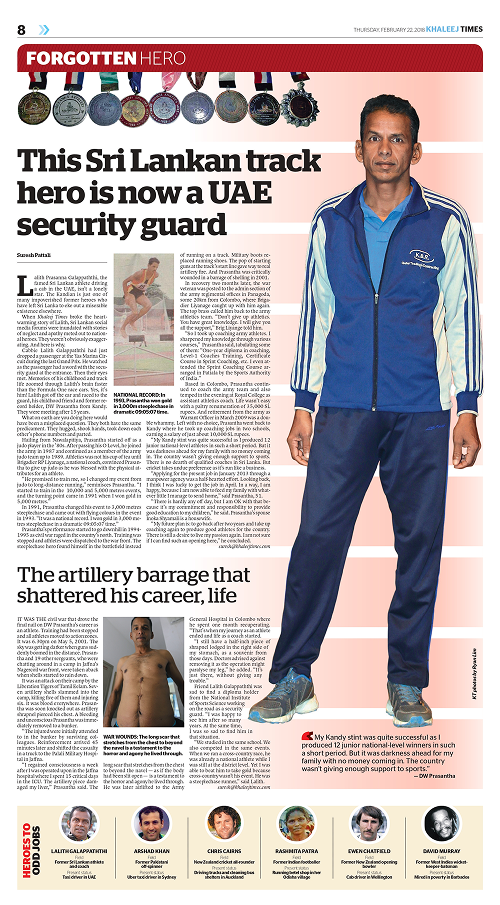
What began as a routine taxi ride for me turned into a deeply moving encounter with a forgotten national hero. The driver, a middle-aged Sri Lankan from Kandy, revealed in casual conversation that he was once an international middle-distance runner who had competed alongside legends like P. T. Usha and Shiny Wilson. His quiet dignity and matter-of-fact narration hinted at a life that had seen both glory and neglect.
Lalith Prasanna Galappaththi’s journey into athletics began with determination and a promise to one day represent his country. Training under reputed coaches, he steadily rose through the ranks, winning local and national competitions before making his mark internationally. His breakthrough came in the mid-1990s when he set a national record in the 1,500 metres and went on to win multiple international medals, establishing himself as one of Sri Lanka’s finest middle-distance runners.
At the peak of his career, Lalith brought pride to his nation with gold medals at international meets in Malaysia and Indonesia, along with a bronze at the South Asian Games. Over time, he accumulated an impressive tally of achievements across 14 international competitions. However, injuries eventually cut short his Olympic ambitions, marking the beginning of a difficult transition away from competitive athletics.
Despite his accomplishments, financial stability eluded him. Jobs offered during and after his career came with meagre pay and little support. Even a coaching position with the Ministry of Sports could not provide a sustainable livelihood, forcing him to leave Sri Lanka in search of better opportunities.
His move to the UAE, first as a hotel worker and later as a taxi driver, was driven purely by the need to support his family. Today, Lalith works long hours behind the wheel, sending most of his earnings back home to ensure a better future for his children.
Though life has reduced his dreams to practical necessities, his passion for athletics remains alive. He continues to train regularly and hopes to return to the sport as a coach, possibly in the UAE, where he believes his experience can still make a difference.
His story is a poignant reminder of how nations often celebrate their heroes in moments of victory but fail to support them in the long run. Lalith’s life reflects resilience and quiet perseverance, but also underscores a broader issue — the neglect of sportsmen once their days in the spotlight are over.
Lalith Prasanna Galappaththi, the celebrated Sri Lankan athlete now driving a cab in the UAE, is not alone in his plight. He represents a growing number of former national sports heroes who, due to neglect and lack of support back home, have been forced to seek a difficult livelihood abroad. When his story surfaced, Sri Lankan social media was flooded with similar accounts of forgotten athletes struggling to survive—stories that reflect a deeper, systemic issue.
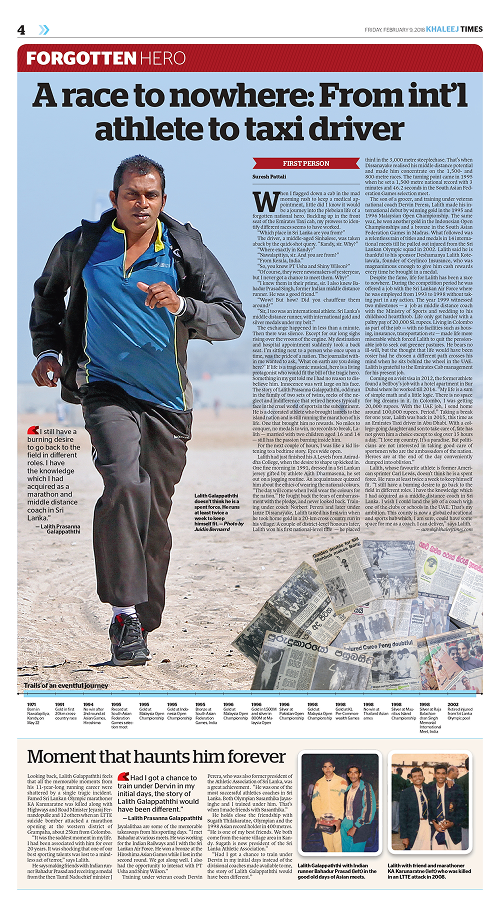
During a recent Formula One weekend at Yas Marina Circuit, Lalith experienced an emotional reunion that underscored this reality. After dropping off a passenger, he recognized a security guard as his childhood friend and fellow athlete, DW Prasantha. The two had not met in 15 years. Their brief, heartfelt exchange revealed a shared fate: both former sportsmen now working modest jobs in the UAE to support their families.
Prasantha’s journey mirrors the rise and fall of many athletes of his generation. Originally a judo player in the 1980s, he transitioned to long-distance running under the guidance of a national coach. His dedication paid off when he won gold in the 5,000 metres in 1991 and later set a national record in the 3,000 metres steeplechase in 1993.
His athletic career, however, was disrupted by Sri Lanka’s civil war, which forced him into active military duty. The war took a heavy toll. Prasantha was critically wounded in 2001, and his life shifted away from competitive sports. Though he later returned to athletics as a coach, gaining qualifications and training others, financial stability remained elusive. Despite contributing to the development of young athletes, his earnings were meagre, and retirement from the army further worsened his situation.
Back in Kandy, he continued coaching and even produced a dozen junior national-level athletes. Yet, the lack of institutional support and the overwhelming focus on cricket left him struggling to sustain his family. Eventually, with limited opportunities and mounting financial pressure, he sought work abroad, securing a job in the UAE in 2013.
Today, Prasantha endures long working hours with few breaks, driven by his commitment to provide for his family and educate his children. Despite the hardships, he still dreams of returning to Sri Lanka to coach again and nurture future talent. His story, like Lalith’s, highlights not just personal resilience but also the urgent need for better recognition and support for athletes beyond their years of glory.